CaRLi-V: Camera–RADAR–LiDAR Point-Wise 3-D Velocity Estimation
Abstract summary
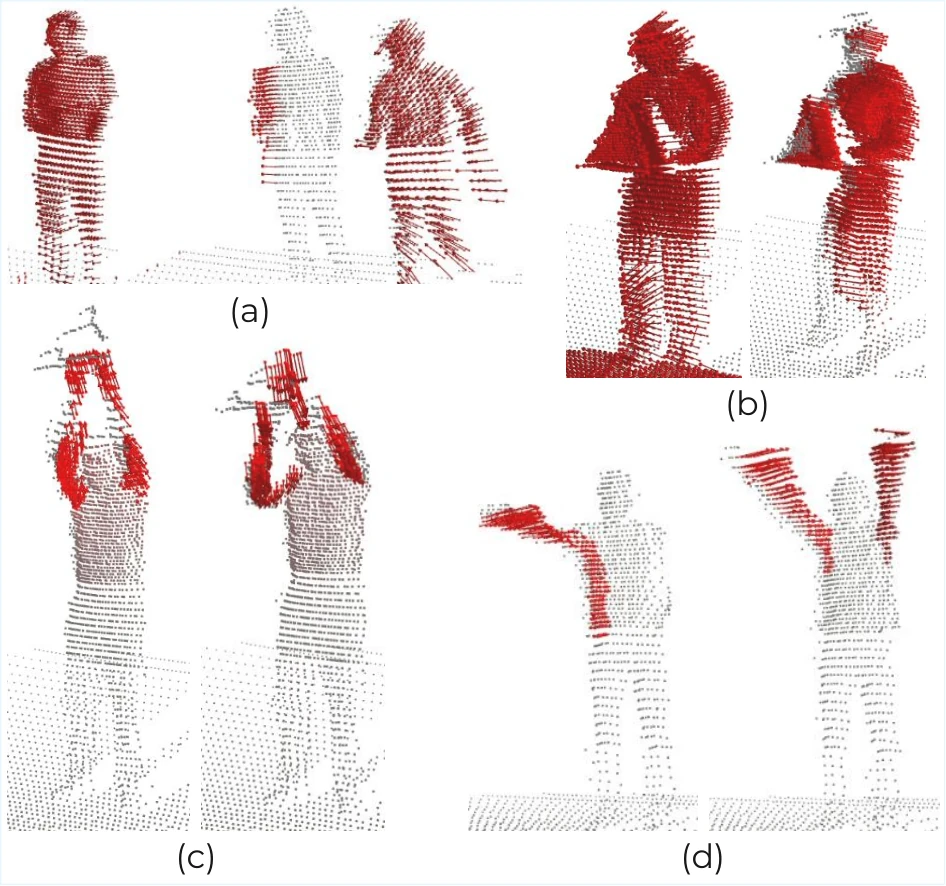
CaRLi-V estimates three-dimensional motion at individual points, including points on people and other objects that do not move as rigid bodies. Radar supplies radial velocity information, camera optical flow constrains tangential motion, and LiDAR provides the corresponding range measurements. A dense radar representation, called the velocity cube, makes Doppler information available for this fusion. The measurements are combined through a closed-form calculation to recover complete velocity vectors rather than only motion toward or away from the sensor. Tests on a dedicated dataset compare the estimates with ground truth and with existing scene-flow methods. The implementation is released as a ROS 2 package for applications such as motion-aware navigation and interaction.