Deep learning frameworks to learn prediction and simulation focused control system models
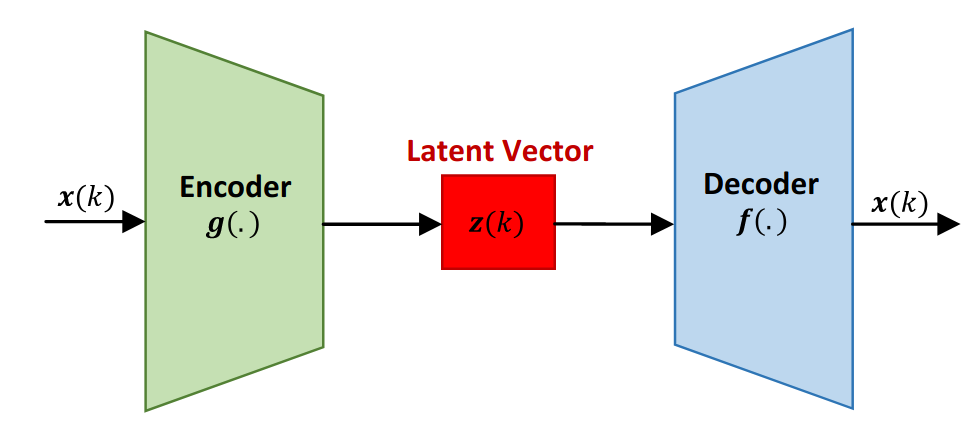 Autoencoder Structure Source
Abstract summary
The paper develops deep-learning frameworks for time-series forecasting and nonlinear system identification. Autoencoders learn compact representations, while long short-term memory networks capture temporal behavior. These components are organized into prediction-focused and simulation-focused models, reflecting the different requirements of estimating the next observation and generating an evolving system trajectory. The work explains how to construct and train the architectures and gives practical guidance on combining their components. Benchmark problems and real-world datasets are used to compare the proposed models with conventional, shallow and other deep neural networks. The experiments show that useful modeling accuracy can be retained with a low-dimensional feature representation, supporting compact learned descriptions of nonlinear dynamics.
Turcan Tuna
PhD Candidate at Robotic Systems Lab, ETH Zurich
My research mainly focuses on incorporating state-of-the-art optimization and machine learning approaches into robust localization and mapping frameworks. Specifically, I specialize in robust localization and perception in degenerate and challenging environments utilizing optimization and learning based methods. Additionally, I am highly interested in multi-modal fast volumetric mapping and efficient and consistent local and global representations.