Diffusion Based Robust LiDAR Place Recognition
Abstract summary
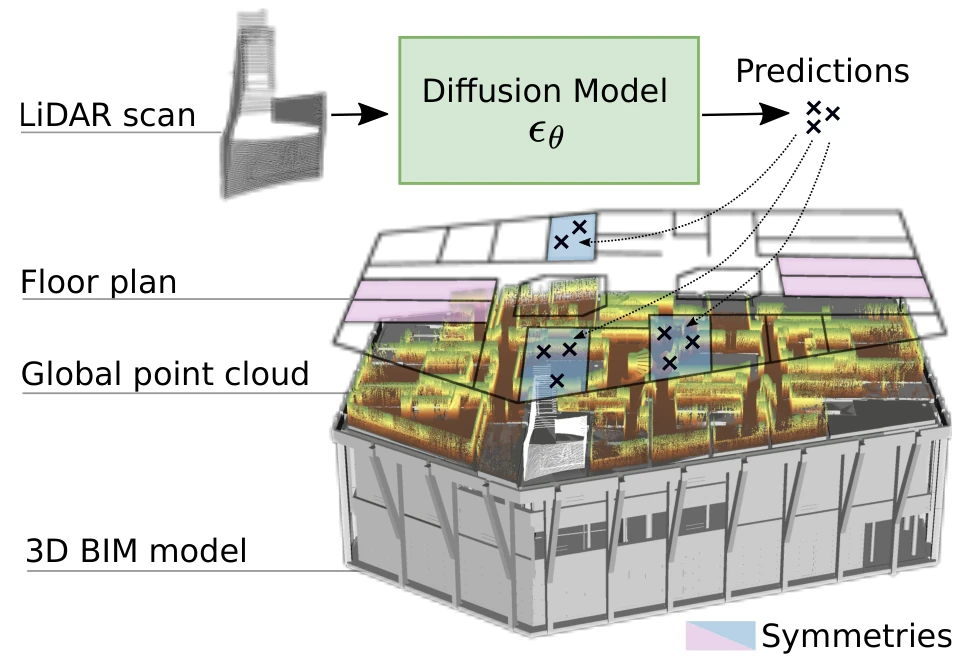
This work studies global LiDAR localization in construction environments with repeated layouts and weak geometric distinctions. Training data are generated by simulating scans inside an accurately surveyed building mesh, reducing the need to collect labeled robot trajectories on site. A diffusion model with a PointNet++ backbone learns a distribution over possible positions from a single scan. Producing multiple hypotheses allows the method to represent ambiguity when several parts of a building look alike. Evaluation on five real-world datasets measures its ability to recover location despite the gap between synthetic training scans and real measurements. The paper reports an average of 77% of predictions within two meters and roughly half the mean error of the evaluated baselines.